
Exhibition 22.02 – 14.03.2023 at Tischenko Gallery, Helsinki
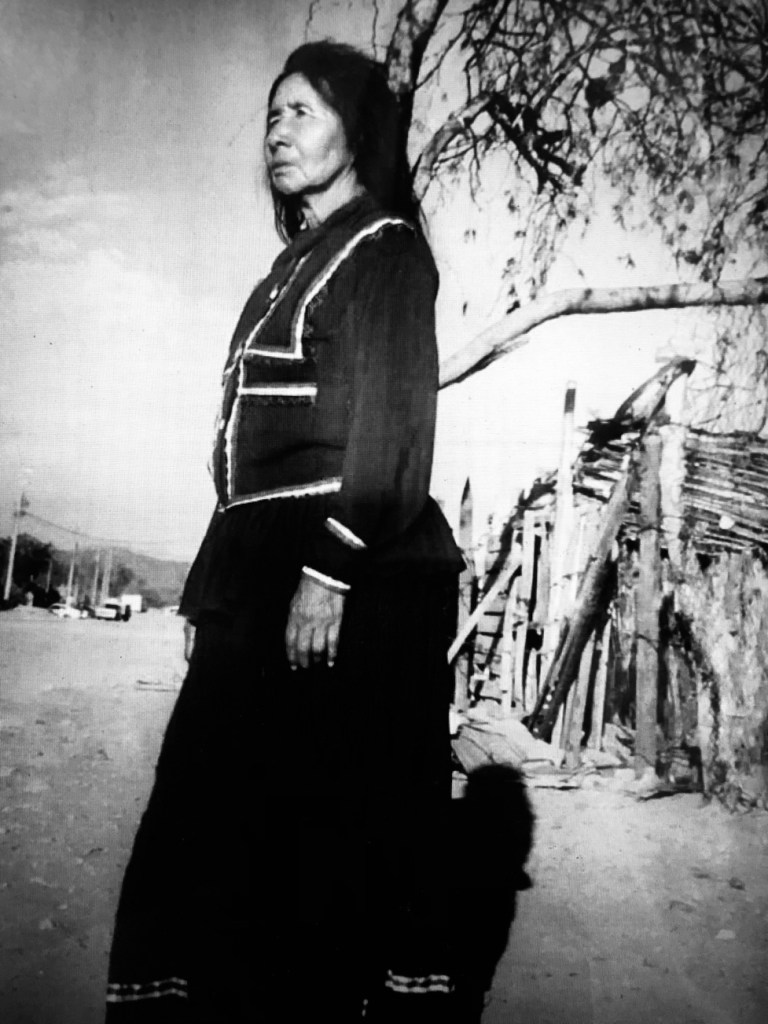
Amalia Astorga was a Seri (Kunkaak) shaman woman and village elder, from the small community of Desemboque located on the coast of Sonora State in Mexico. She was part of the remaining Seri Nation (in actuality less than a thousand people) who live between two communities, Punta Chueca in the south, and Desemboque in the north, at the edge of the Sonoran desert and at the edge of the ocean’s water in the Gulf of Cortes. The Seris are an independent linguistic group, and from the known basket makers of California, they are living most south inside of Mexican territory. They were hunters, gatherers, and fishermen and they conserved their nomad life up until 1945 (that nomadic habit is still conserved between the two communities and an intermediate camp in between known as Punta Sargento). Within the native groups of norther Mexico they were perhaps the most isolated and difficult to access. They were still considered “savage” or difficult to communicate with whites and also with the neighboring Yaquis and Pimas, up until the early 20th century. They were never converted to Christianity, with the exception that around the 1970’s the Summer Linguistic Group did a job of evangelizing but by the 80’s the Mexican government forced them out. The Mexican government additionally gave them access to Tiburon Island, which was a sacred territory for them and was converted into a Navy unit and a Mexican army hunting compound. Today they survive thanks to their fishing activities and some contraband smuggling with the Arizona border.
I met Amalia in November of 1986 during my first trip to the area, and I immediately recognized in her the capabilities of a leader and spiritual guide, with a vast knowledge of the plants and animals of the area. She was the daughter of the chief of the tribe Jose Astorga, who was the first to introduce the wooden carvings of “palo fierro” (iron wood), a quality which she inherited from her father which is unusual since women tend to do basket weaving instead of wood carving. She took me to the sacred cave where the shamans were initiated as part of an isolated vision quest which took 4 days and nights, and which also has sacred rock paintings. She was also very knowledgeable in botany and curing with natural herbs and plants. She also knew all the traditional songs and dances.
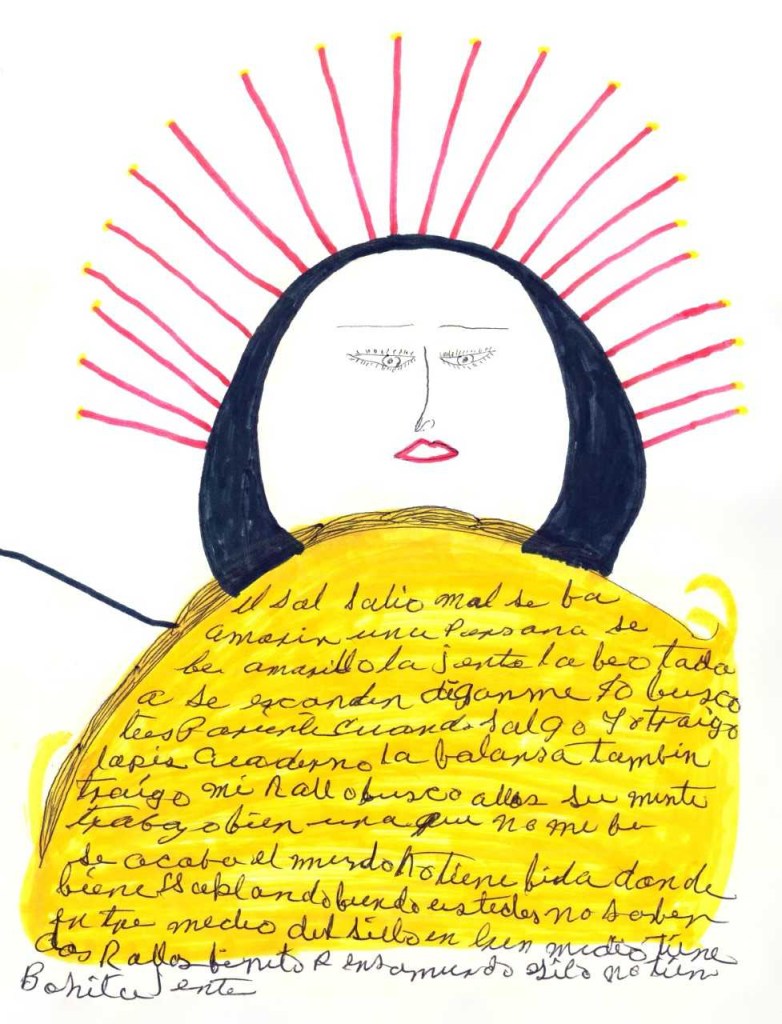
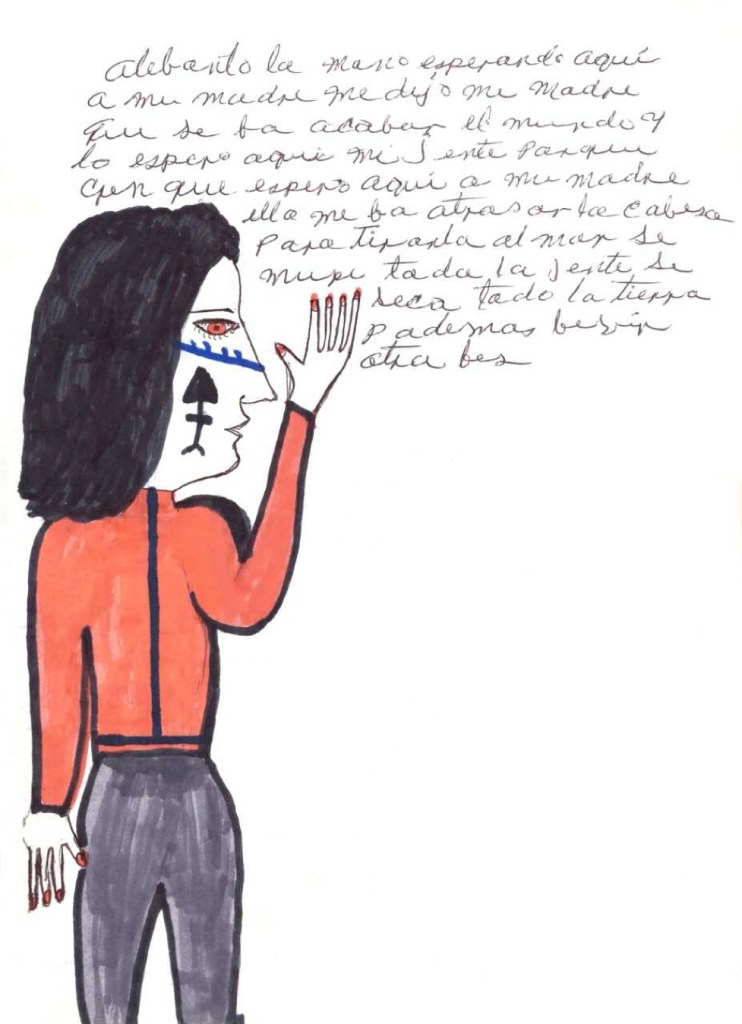
Around the late 1990’s, after she had painted some mono-chord violins for me, I discovered that she had graphic capabilities, and I asked her if she had ever drawn before on paper. She told me she hadn’t and I asked her if she felt capable of making some drawings, and she replied that she would be willing to. So that night I left her my notebook with pencils and pens, and the following morning I had my first 20 drawings by Amalia. From then on, we established an agreement that she would draw school notebooks for me, and when she finished them she would send them to me via mail and I would buy them. I would in the process help her and her family. This took place for many years in which Amalia would send me the drawings, and where she would explain in minute detail the flora and fauna of the region, as well as themes from the Seri mythology and culture. She herself began to incorporate an element of text to, according to her, “explain to Jose” what the images were about. This was a spontaneous collaboration, between her and her son-in-law (Mojarra, who is a mestizo) because she did not know how to write. She died in 2014, during Hurricane Odile which ravaged the Mexican Pacific and Sonora, I calculate she was roughly in her 70’s. She is survived by her husband Adolfo Burgos, her daughters, and grandkids.
Carefully revising the drawings of Amalia we could say that Amalia had two styles of representation, one general in the graphic sense of the tribe, and another more personal. I found this out after I had been checking the studies of anthropologists who had visited the area (the first being MacGee around 1906, then the Coolidge couple, and in the 40’s the young Neil Smith). With reference to the general style, the figures of animals, fish, facial paint, and mainly human figures schematically have a clear and unmistakable Seri patronage in style. These could be executed by any Seri elder even today, without much change. Apart from this she also developed her own personal style, with much more realistic with larger figures in relation to the size of the paper, generally when she made human figures. To the best of my knowledge, Amalia has been the only member of the tribe, to regularly draw about their way of life on paper, based on an original concept based on the wood carvings of “palo blanco” (elephant tree).
Jose Bedia
Contacts
TISCHENKO GALLERY
Fredrikinkatu 64
Helsinki 00100, Finland
+358 468104546
Send us a message to get further details about the exhibition


 We are art